The experience gained in the pursuit of a hobby or passion is can often be quantified in visibly improved skills from one project to the next. A cosplayer can track the complexity of their 3D prints, the construction of their patterns, or the minuteness of detail of their props. Experience is an invaluable teacher; with enough persistence and determination, it can make anyone proficient whatever creative skill they wish. But what of the lessons that cannot be quantified? Rather than the how, what of the why? In my interview with Lutavia, the story of the how of their cosplays – such as documenting each new skill learned with each new build, or their interest in storytelling which led to a fully storyboarded video showcase and photoshoots in carefully crafted settings – quickly shifted into the story of the why of their cosplays. While Lutavia takes great pride in their own work, pursuing cosplay has also shown them the joy and fulfillment found in connecting with, and providing invaluable resources for, beginner and veteran crafters alike that strive to create their own dream cosplays.

Do you gravitate to certain cosplays because they have elements you know will challenge you, or do you pick a design or character whose story or personality clicks with you first, and tackle any challenges that come with their design after? Or is it a mix of both?
Lutavia: I tend to pick my designs based on either (A) new skills I would like to learn or (B) builds that resonate with me in terms of aesthetic, which are traditionally a mix of cloth + armor based designs. My characters I choose do tend to fall into “pathetic/blonde/babygirl” archetype in general, but I also really enjoy large weapons or armor rigging challenges as far as like, “Can I fit this in a suitcase?” Ultimately, if I see a design and I say “I can tell a really cool, beautiful story through this garment and my techniques” it goes on the list!
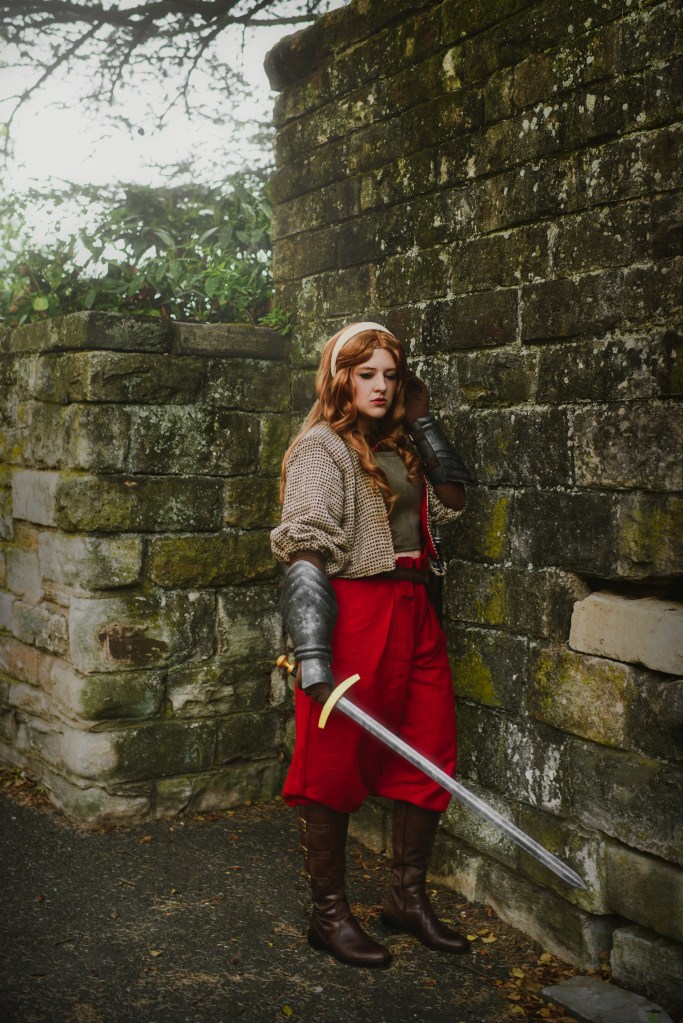
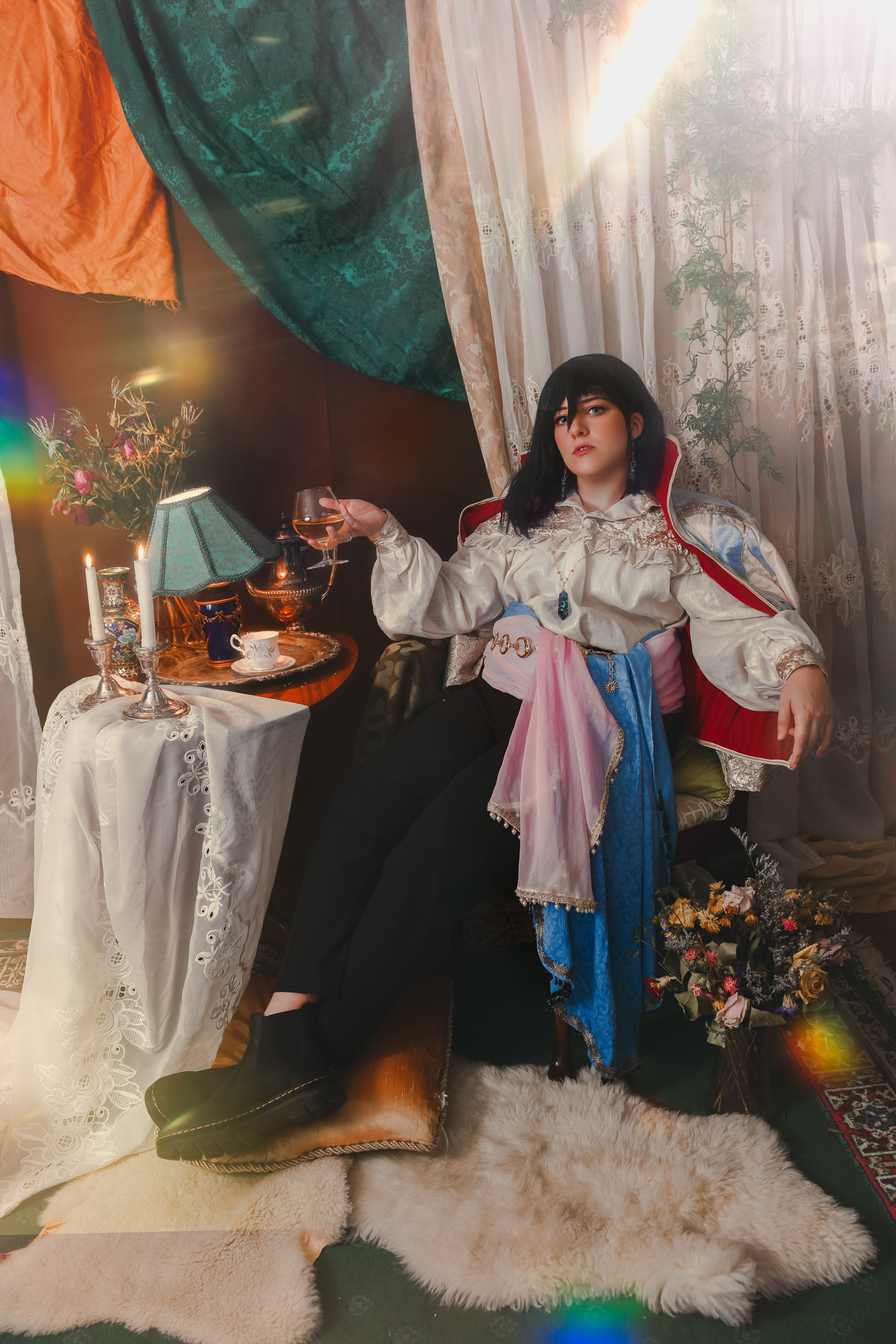
As far as story or personality clicking, I need to feel ‘comfortable’ embodying that character for shoots, so I don’t tend to pick, say, very comedic or loud characters – my most recent picks (Medicine Seller from Mononoke, Dion Lesage from Final Fantasy XVI, even Link from Tears of the Kingdom) are all kind of pretty, quieter types, which is better for me since I’m a terrible actor, haha! For me additionally, being nonbinary (genderfluid and transmasc specifically), I’ve started feeling a lot more dysphoria in costumes that don’t vibe with my gender expression, and is something I’m still discovering with every cosplay I create. I feel incredibly euphoric in my Howl (Howl’s Moving Castle) or Vash (Trigun: Stampede) costumes for example, as the source material is somewhat trans coded, versus someone like Aerith (Final Fantasy VII) or Heather (Silent Hill 3), who I love, but are more ‘girl next door’ types and have a more ‘traditional’ feminine portrayal.
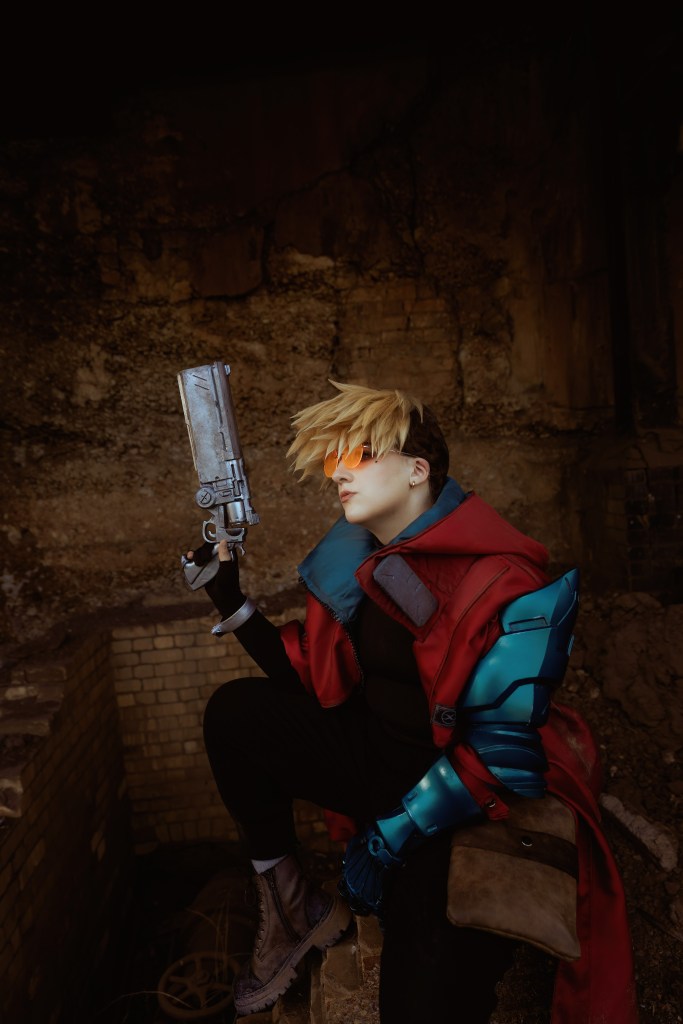

Right – Photographer: Jonathan Vilches
When you build a cosplay with a certain showcase in mind—a contest, a photo shoot, or a video—what different considerations do you take into account in your approach to the outfit’s construction? Are there aspects of construction you would prioritize more than another, depending on where you plan to wear it?
Lutavia: My #1 rule for costume construction is to choose materials, techniques, and approaches that photograph well, because nine times out of ten, my costumes (as I do not compete in traditional stage contests much, if at all) will be seen through a photoshoot. My prioritization order tends to be climate control and logistics/quickly removable (I have a host of health issues that cause easy overheating) first, followed by ease of repair/longevity, and then finally ultimately whether this costume has a deadline or not, which dictates everything from how much research time to budgeting a costume gets.
I am a strong proponent for ‘why be accurate when you can be extra’ and ‘accessibility triumphs all’. I think designing around your health, your climate, your deadline, your budget, your body, even your personal taste – all of that is more important than having the correct number of seams or the hem length you choose. I’m also a strong proponent of ‘done is better than perfect’ – time after time I see cosplayers paralyzed by builds taking years upon years because they repeatedly redo things over and over. I suggest instead cosplayers accept something as ‘done’, and either later upgrade or take their learnings to their next project.


Creating tutorials and offering advice to make cosplay more accessible has become a large part of your social media presence. Is putting out your advice and expertise to a wider public audience at all intimidating, or has it come to you fairly easily?
Lutavia: So, my degree is in software engineering, and I actually partially paid for my living expenses in college as a tutor. I’ve always been fascinated by the topic of education – it was also my college thesis – and I’ve never really shied away from being eager to help people be a part of something that means so much to me, whether that’s software engineering or nowadays, cosplay. So I guess I’ll start by saying that no, I don’t really find it as intimidating (especially after doing this for quite a while now!), and personally I believe that good connections require a bit of exposing your vulnerabilities, and this is no exception.
I’m a strong believer in rising tides raising all boats, and I also believe that transparency in terms of the maker process is what demystifies and allows hobbies like cosplay to bring in a frankly more diverse and welcoming audience. And, frankly, I know any mistake I post about in my builds, any failure, any struggle – I know every cosplayer ‘gets’ that. And the more you do it, the easier it gets, too. I’m surrounded by a great group of fellow makers who are also resource creators and we’ve all kind of banded together in this attitude that if we’re all open about our process, it’s a lot less intimidating if we do it all together.

You label yourself as a “cosplay educator and cosplay content creator” first and foremost on your social media. What prompted the shift of your focus from just creation to creative education?
Lutavia: I got my first guest gig in 2020, I believe, and by then I was certainly interested in paneling a lot and teaching folks but I wasn’t really doubling down on the education angle. A lot of other folks making educational resources had inspired me, but I wasn’t really sure how to angle myself in that space or even what my cosplay identity was. But, long story short, I judged a beautiful costume in the Novice category in that con who unfortunately did not win. And, miraculously, we ended up at the same bar that night having a drink at the hotel, and she was still teary-eyed about it all, and we talked.
Ultimately, the conversation turned to ‘I want to guest like you, and you have to win awards to do that’, and I calmly told her I had not won any awards! I had applied for this and gotten it based on my work, and my love of teaching others, and it was like a lightbulb had appeared. ‘Oh, I never thought of that–it does seem cool, helping people’, and that’s when I realized that I could do a lot more good in the community by spending time and energy on documentation and resources. This kind of sunk in deeper throughout the weekend as I actively talked with people at my table the whole con, helping consult on dream builds, and as I hosted Q/A at my panels on everything from planning costumes to finishing 3D prints.
After that, I changed my social media bio, and I re-worked my press kit to have a very clearly educational focus, and I truly went all in on the concept. To this day, although I have won a couple of prizes I’m certainly proud of, my motivation is remembering every single person who DMed me to tell me they used my build thread for a build, or they downloaded my vector to use for their costume, or even people who DM me for help and then return a year later to show me what they built. It feels like I’m creating something bigger than myself, and that the impact of teaching others the joy of creating will outlive me – and what feels better than that?

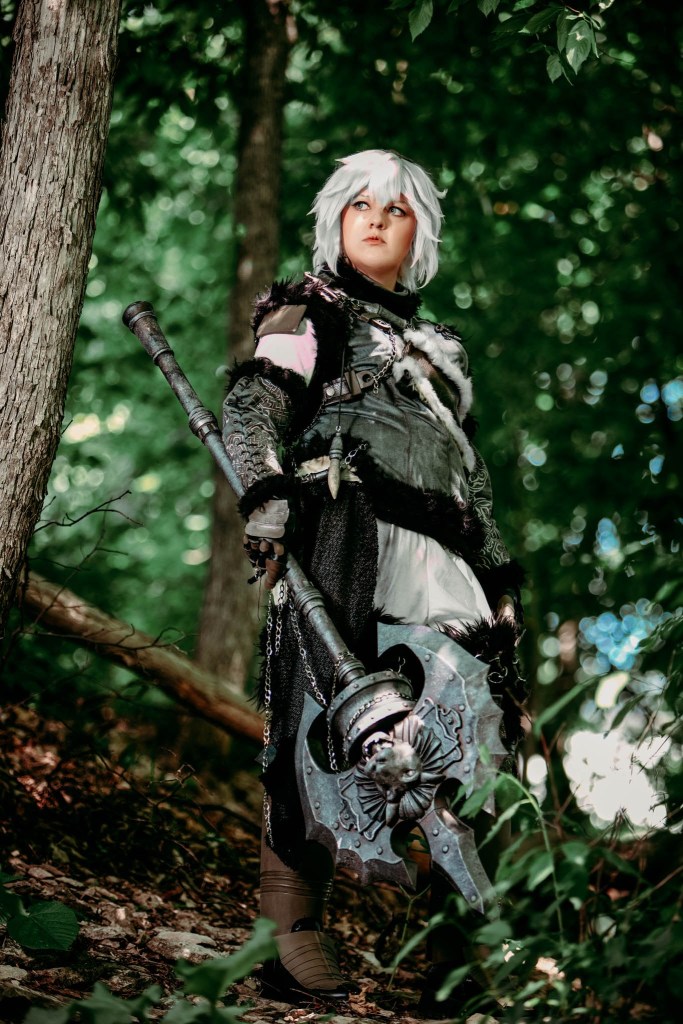
Right – Photographer: Heavenly Visuals
By attending cons as a cosplay guest and judge, I’m sure you see the full range of cosplayers—both in skill and personality. Has this more personal interfacing with the cosplay community influenced your own perspective on cosplaying? and has it been a large part of your drive to create accessible education for people interested in cosplaying?
Lutavia: Oh, absolutely, no question. Even attending cons as just an attendee, I try to meet up with mutuals who are makers or even just people in my local community. It’s really inspiring to me to see what people at even novice levels are doing these days. I joke that I learn as much from the contest entries as my fellow judges, even.
But, I have been to cons that are very, very lacking in educational content in some regions, and you can tell – so I’m hoping to maybe more proactively start up maker meetups at cons I go to, if not ones I’m already paneling at, so even if the panel programming isn’t super stacked, crafters don’t have to feel like they’re making in a vacuum. It’s really validating to wonder if you’re doing the right thing, and then you run into folks at cons who say things ‘oh, I’ve been following your build thread for X, it’s so great to see it in person’ or after a panel have folks personally thank you for taking your time out to teach something.
I live for the ‘lightbulb moment’ when I can help folks at any level, and even if I’m not a formal guest, I am obsessed with sitting and talking shop. Theorycrafting, experimenting, sharing our experiences, it’s truly unmatched when you get to do it at a con versus online. It’s certainly also made me more ‘aware’ of community pockets around the country, and sharing the Texas scene with other folks and hearing what other folks are seeing has been great to bring back to my community (and vice versa) too. So I guess the TL;DR is that yeah, it’s certainly reaffirmed my personal mission, and I’d hope that maybe I’ve inspired a few folks to give it a shot in their own communities too.

I’d love to touch on your growing focus on “storytelling” in a costume over the course of your cosplay journey. You mention approaching the weathering of your San (from Princess Mononoke) cosplay with a more “purposeful” approach, which also seems relevant for the “‘organic’ weathered look” you applied to your male Viera cosplay that followed. What pushed your creative focus towards detailing your cosplays with consideration to story-focused costume design?
Lutavia: I think frankly it’s always been something I’ve been interested in. When I took art classes, character design always fascinated me, and as I got older and got into movies, I was always awed by production design and costume design – why people wore what, what those outfits and sets meant. At the same time, it also helped differentiate my costumes from other people’s, and it also helped me compare myself to others a lot less. Though I think everyone can and should cosplay whoever they want, and the more the merrier and all that, it’s easy to get caught in your own head that your own version isn’t as good as someone else’s. In the beginning, adding a storytelling element helped me focus less on obsessive accuracy and bringing my own interpretation to the table, and as I continued to make costumes, I realized it was something I was just very naturally interested in due to my film background.
I still think about this at every step, from material sourcing to technique selections, and one of the most common compliments I get is on those things, how my costumes feel like movie versions or are very texturally pleasing, so – I guess it works out well. I just can’t imagine picking all these things without some kind of ‘north star’ – and in my case, a character’s story, the world they live in, that’s kind of my guide.
And I think if whoever is reading this is like, interested in that sort of thing, I would suggest looking at a lot of film and television costume design for fantasy and non-fantasy, and reading analysis about symbolism in color and silhouettes from that regard – even fashion runway, like couture stuff, is part of a ‘theme’ or ‘message’ that’s being sent about a collection, so look there too. And from a cosplay perspective, just thinking about “would they take care of their stuff? Where do they live? What materials could they realistically get a hold of?” are all good questions to make your own choices on costume materials and techniques.


Right – Photographer: FXDandy
It’s probably no coincidence that your creative output with your cosplays— your cosplay feature performance video for Crunchyroll Expo’s Cosplay Cup in 2021 with your male Viera, of course, but also your set design and location photoshoots for cosplays like Meteion, Heather Manson, and Howl—has also evolved from your first few photoshoots. Were you always interested in the presentational aspect of cosplay, or is that something that has been unexpectedly rewarding to explore?
Lutavia: I’m actually a photographer as well as a cosplayer, and my interest in photography bloomed from movies. I only photographed people, but some of my first real photography jobs to help pay for college were in three areas: photojournalism, editorial, and theatre, specifically opera. All of those are all about showing a story in a single photo, or giving a vibe or atmosphere, and I treat my own shoots as collaborations with my photographers rather than a hand-off. I grew up seeing these elaborate cosplay shoots on DeviantArt, things bordering on art, and after my first couple of costumes, I found myself drawn to the idea of CMVs – cosplay music videos – but they always felt like weird, kind of model-focused costume showcases. I really just wanted like, a movie, just with a cosplayer as the center.
Also, I work really, really hard to tell a story through my costumes, so I personally think a photoshoot that reflects that is a natural part of that process. I want the focus to be on the character and the costume, and not myself, as a model, but instead as a cinematic subject, as a part of a scene, versus something like a glamor shot. These elaborate shoots are often a reward and a deadline all at once for me too, since I don’t really compete and my con schedule is a bit haphazard.
Anyways, I think everyone should give it a try – make a Pinterest board of movie scenes and paintings that you feel fits the character, gather pose ideas, watch movies that might influence your shoot, whether literal or symbolic. I know recently to prepare for my Trigun shoot I re-watched Mad Max: Fury Road and Blade Runner 2049, and when I was thinking about Howl, I was checking out clips of stuff like Sofia Coppola’s Marie Antionette and other very indulgent looking films. And don’t be scared to share these with your photographer – almost always when I give a pinterest board or ideas, they’re always very kind and excited that I have a vision.


Are you ever concerned about the long-term accessibility of your work? Twitter, Instagram, and TikTok are excellent for wide-ranging and immediate social outreach, but are notoriously difficult for organized archiving and searching. Changes Twitter over the last year have a lot of creators concerned for the longevity of their work on platforms they ultimately can’t control as well. Do you share some of those same concerns, and if so, have you started to look into more reliable platforms for showcasing not only your finished work, but also your informative technique and cosplay build tutorials?
Lutavia: I actually do have a personal website for my work including work writeups, and gradually (so, so gradually) I have been archiving and preserving my personal build threads to be translated into PDFs and stored there, or in blog posts. I work in tech so the ebb and flow of platforms is real, but no one can tear your personal website out from under you. Additionally, I use Discord extensively for crafting discussions, which isn’t ironclad either (see: Skype, AIM, MSN messenger, whatever), but at least is another host. This is my ad to tell everyone to make a personal website (and have a nice backup, physical hard drive and a cloud one for your stuff) because it is not only more professional but basically required in a time where not everything hits the Wayback Machine, you know?

You painstakingly document your cosplay builds in detailed Twitter threads—patterns and plans, first and second attempts, techniques, materials, finished products. Has investing the time in learning how to show each step improved your work in ways that might not have happened had you not had to so closely analyze and present your process?
Lutavia: Haha, you’d think if I documented this stuff so closely, I wouldn’t make the same mistakes, right? Unfortunately, that is not the case, as I’m human like anyone else. But, what it has done is replace my very human and very shoddy memory. I do go back and read through my threads to help others extensively (so nice to have visuals for folks) and it does remind me of choices I made (and what I would do differently!). It also allows me to recall how I felt and why I reached that conclusion, which helps me reflect on builds for paneling as I often use examples, too.
What it has unexpectedly most helped me with is actually discovering new ways to do things, too – I will openly show when something is giving me grief and people will chime in with (most of the time) helpful advice or approaches. Sometimes they are stuff I have considered, but often they aren’t, and even if I’ve already decided the path, the fact they commented at all and shared knowledge is in its own way a form of tutorial or cosplay resource creation that could help a passerby. We joke and call this ‘cosplay resource osmosis’, when you stumble upon a comment, a post, anything, that may not be relevant now, but you may recall for yourself or someone else later, and it’s probably the most common way a lot of folks get resources due to how algorithms work these days.

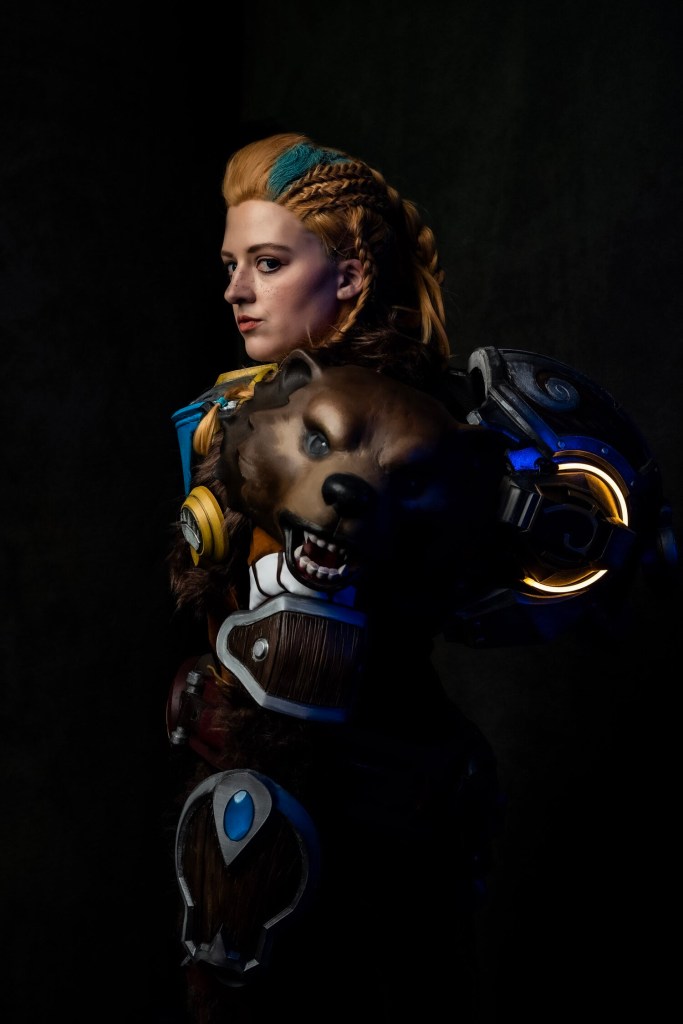
Right – Photographer: Jonathan Vilches
The most skilled cosplayers I come across are often creators who have been cosplaying for well over a decade now, and in that time they can accumulate not only a wide range of skills, but—perhaps more importantly—improved materials, tools, and maker spaces. The increased accessibility of techniques like 3D printing and materials like cosplay-specific fabrics is a boon for the growing community, but the sheer amount of resources and techniques available—and how long it can take to accumulate them—can also widen the gap between even your average creator and someone who is just starting their cosplay journey.
Do you think your educational work not only helps creators along wherever they are in that journey, but can also encourage better support and connection throughout the community? Is that something you hope to foster through the Online Cosplay Tutorial Challenge, an online initiative showcasing cosplay tutorials that you co-founded with Paige Knovice of Knovice Cosplay?
Lutavia: That is actually one of our goals, I think. Besides showing cosplay tutorials and resources come in all shapes and sizes for all skill levels, our contest also encourages the idea of sharing with the community for the good of the community. Although we certainly incentivize folks with prizes in the contest’s case, we have found more often than not people who make an entry go on to continue making resources in some way, typically through build threads or sometimes small reels or similar on specifics. I think we’re all aware of the demise of Cosplay.com, or DeviantArt, or Tumblr posts, or websites long gone dark, all filled with lost resources like some kind of library of Alexandria – nowadays, we do have better tools for preserving information, and we should all do our best to contribute to ensuring it’s not lost again.
I want to briefly mention too I haven’t been in this game long – I started making props in 2017, finished my first costume in 2019 – and frankly the only reason I was able to level up as quickly as I did was due to cosplay educators being kind enough to spend valuable energy to create resources from online tutorials to whole books, often times for free. I remember even as a preteen, after being wowed by cosplayers at my local con, digging around Cosplay.com threads or DeviantArt tutorials to demystify the things I’d seen. Years later, I’m thrilled to call some of them my friends and see others are still going strong, so I support them – I throw every dollar at their Patreons, or buy their books, or just share their resources, because I strongly believe if we want this hobby to continue to diversify and grow and be approachable for newcomers, we gotta give creators the support to make this viable and newcomers the tools to succeed.
It’s easy to say ‘back in my day’ and lament about things being harder, that these new folks have it so easy nowadays – but I abhor that behavior with my entire being. It makes my blood boil. I don’t think our past suffering should become a requirement for newcomers, and I think the more we lower the bar of entry through providing resources, through encouraging companies to provide materials in accessible ways, to new tools that help folks of all abilities build stuff, the better. Helping folks discover the joy of making costumes in their own way – whether that’s buying or altering, thrifting clothes, making from scratch, whatever – is my primary goal and always will be because nothing will ever bring me more joy than seeing someone discover that yeah, they can make stuff, even if they once believed they couldn’t.
Every time I help someone, and I see them finish their first (or their latest) costume and share it with the world with such pride, I think of how I felt when I finished mine and of the road I took to get there, and I’m filled with an incredible joy and gratefulness to be a small part of that journey for someone else.
You can find Lutavia at their website, Lutavia Cosplay, or check out their Twitter and Instagram!


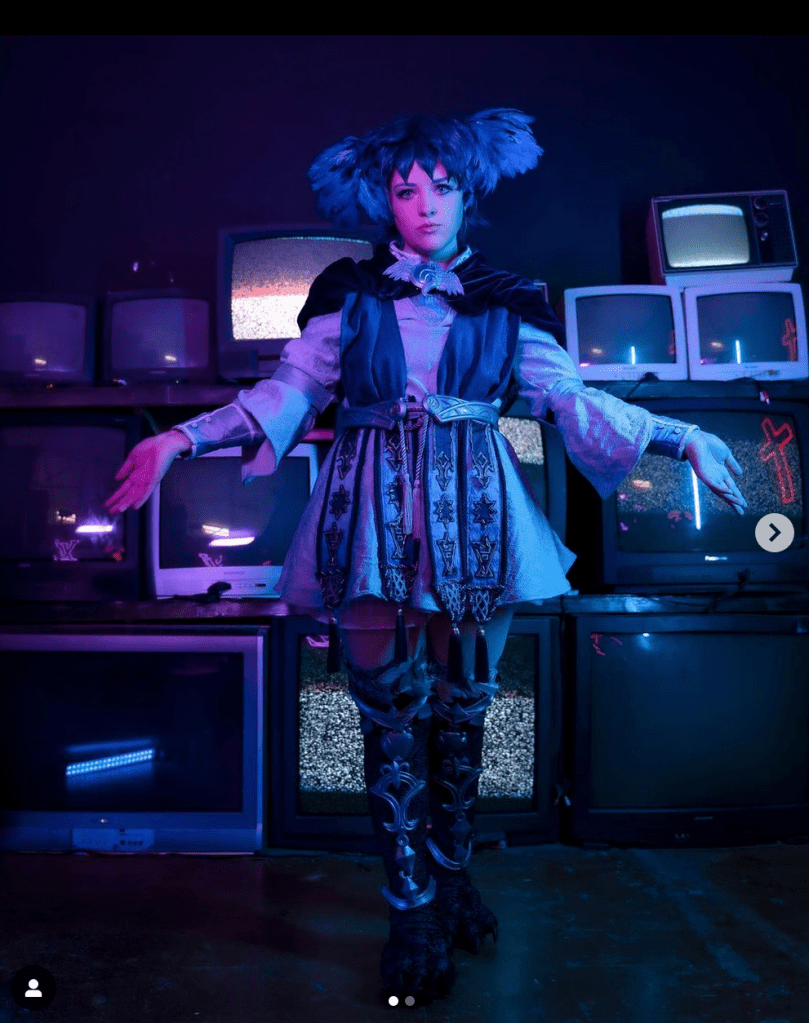
Top Right – Photographer: yinphoto
 Inquiries of Art
Leave a comment